Level Designer
A Boy & his Bug is my final school project on which I worked as a Level Designer for a year.
In this game, you play as Mik’ro, a child only a few centimeters tall, who explores an abandonned House mounted on Skr’ab, his faithful beetle steed.
This duo will embark on a quest to find Mik'ro's big brother Mak'ro, who went missing under mysterious circumstances. To find Mak'ro Mik'ro and Skr'ab will have to explore an abandoned human house, filled with wonders. Though they're going into the unknown, they're not going unprepared.
Thanks to Skr'ab ability to climb on all kind of surfaces and Mik'ro's hook which allow him to interact with objects way bigger than him, they're more than ready to go on an adventure.

A Boy & his Bug
A Boy & his Bug is a third person puzzle-adventure game I worked on as my graduation project. You will play as Mik'ro, a boy a few inches tall and his mount Sk'rab, a beetle that can climb anywhere. You will follow them in their quest to find Mak'ro, Mik'ro's missing big brother.
I worked on this project as the level designer in charge of the tutorial and as the team's producer.
Walkthrough

Conception - Tutorial
Intents
2 Main Intents, with a focus on gameplay and narration
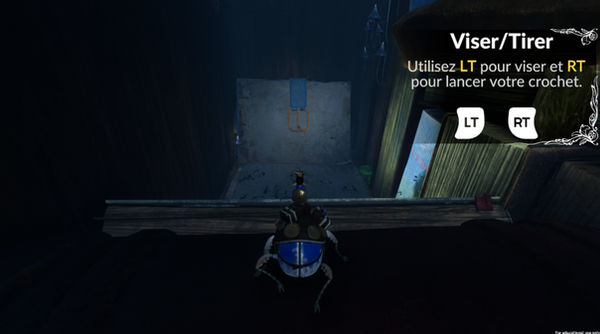
Teach the game logic : While playing the tutorial the player needs to not only learn the game mechanics but also learn the basic logic that every puzzle in the game will apply.
Focus on the character : I want the tutorial to be a space in which the player will only have to focus on learning about the controller gameplay-wise and story-wise.

Researches
Before designing the level design I made a lot of researches about what I could do with the ability to climb anywhere.
Geometry Researches : Once I got my hands on the controller, I tried and documented a lot of things with the geometry in order to understand what the player could feel
Puzzle Researches : I did the same thing with puzzles, listing every way I could of to exploit the controller.

Flowchart

1
>

2
Enter the Alleys
Explore the Alleys
>

3
Lean to push

4
Train to push
>

5
>
Learn the hook

6
Train the hook (1)

7
>

8
>

9
Train the hook (2)
Exit the tutorial
Cutscene
Design Techniques
Teaching the game logic
In the intents, I spoke about teaching the game logic to the player alongside the game mechanics. It's a necessary step for him to understand that he needs to look at the puzzles at 360°.
I used the geometry to incite the player to climb walls and lead him to already completed puzzles in which he only has to follow the tutorial's instructions.
I also used the lighting to mark the path and focus the player attention on what he need to do.

Build intuitive puzzles
To make sure the player will not lose too much time understanding the puzzles goal, I made them as intuitive as possible using multiple techniques.
Use logical interactions : In every puzzle the player will interact with object that are anchored in our reality and think of a different way to use them. For example, a book can become a bridge if he open it using his hook. I worked with the artists to make those interactible objects affordable, making sure the player wouldn't miss them.
Use the environment to give hints : I gave hints to the player using the geometry to mark his path and worked with the artist to make visual clues to the puzzle solution.
Focus one interaction at a time : To make sure the player doesn't get confused, each puzzle in the tutorial is making him focus on one interaction at a time. It may be followed by another one to make him understand how the controller abilities interact with each other but I always made sure to not overload him while he is learning.

Conclusion
A Boy & his Bug is the confirmation of my 5 years of studying at Rubika. I was able to work a full year on a project, challenging my skills as a Level Designer and my ability to manage a team of 10 people.
As any project, A Boy & his Bug still has room for improvement.
More free running - A really satisfying mechanic is the ability to climb on walls, meaning the player can go anywhere. I find the currents levels lacking in that aspect, and I would have worked more on the exploration part of the puzzles if I had the opportunity.
Better space management - If I had to find a flaw to the tutorial level and the levels overall, it would be the space management we made. I believe we could have better thought our space design and it's impact on our puzzle's space in order for them to include more free running and exploration, which I find to be the funniest of the gameplay.
Overall this project made me confirm my skills on Unity and my ability to manage a full team while ensuring my levels delivery. I'm pretty proud of this project, as I got a lot of great feedbacks from multiple industry professionals.
Thank you for reading !